
Made by
Aristocrat
Explore Where’s the Gold results, RTP, payouts and biggest wins. See how this Aussie pokie pays and what realistic session outcomes look like.
18+ only. New players only. Wagering requirements apply. Play within your means.
Made by
Aristocrat
RTP
95%–96%
Volatility
Medium to high
Best payout
1,000x
Style
Classic 5-reel
Bet range
AU$0.01–AU$100
Where’s the Gold results come down to one thing: a clearer idea of how this classic Aussie-style pokie actually pays. This page brings together the key facts behind Where’s the Gold game results, including payout behaviour, RTP, volatility, bonus-round performance, and the kinds of wins players typically see over real play.
It’s important to start with one simple truth: Where’s the Gold uses random number generation (RNG), which means every spin is independent. No previous outcome makes the next spin more likely to win. Even so, looking at long-term maths such as RTP, hit frequency, and feature potential can help you understand what a normal session may feel like and where the biggest payouts usually come from.
On this page, you’ll find:
This is an information page rather than a live tracker. The examples below are based on the game’s mechanics, common configurations, and long-term theoretical behaviour, so they’re best used to set expectations and support responsible play.
When players talk about Where’s the Gold win results, they can mean a few different things. On the simplest level, results are the outcome of each individual spin: either no return, a small line hit, or a stronger payout. On a wider level, results also describe your overall session performance—whether you finish ahead, behind, or roughly even after a run of spins.
There’s also the long-term view. In slot terms, results are often judged through RTP performance, volatility, and the share of total returns that come from base-game hits versus free spins and special features. That’s why two players can have very different short sessions on the same game, even though the maths behind the pokie remains the same.
The core engine behind the game is its RNG, or random number generator. That means:
This is where a lot of confusion starts. Many players search “Where’s the Gold results today” hoping to find out whether the game is “hot.” In statistical terms, that idea doesn’t hold up. A machine or online slot doesn’t become more generous because it paid poorly earlier, and it doesn’t become “cold” because somebody else hit a strong bonus round.
What players usually care about falls into three broad result types. First, there are small but more frequent wins, often from low and mid symbols. Second, there are medium payouts, which tend to come from stronger reel combinations or stacked symbols. Third, there are big win results, usually linked to free spins, wild assistance, or premium symbol coverage across multiple paylines.
Over time, even a solid RTP game still includes a house edge. That means losses are the expected long-run outcome, which is why Where’s the Gold should always be treated as entertainment rather than a way to make money.
Common myths worth ignoring:
RTP, or Return to Player, is the theoretical percentage of all wagered money a pokie returns to players over a very large number of spins. If a version of a game has an RTP of 95%, that means it is designed to return about AUD 95 for every AUD 100 staked over the long run. It does not mean you’ll get 95% back in your next 20, 50, or 200 spins.
For Where’s the Gold, the reported RTP is typically in the mid-90% range, with many online configurations sitting at roughly 95% to 96%, depending on the operator, platform, and jurisdiction. Some versions may be set a little higher or lower. In Australia, that matters because different venues and online operators can run different configurations, especially where local rules and platform settings apply.
Just as important as RTP is volatility. Where’s the Gold is generally viewed as a medium to medium-high volatility pokie. In practice, that means it often delivers a mix of smaller base-game hits and less frequent but more meaningful feature wins. Compared with very high-volatility slots, it may feel a little steadier, but compared with low-volatility games, you should still expect noticeable bankroll swings.
Another useful concept is hit frequency—how often spins return any win at all. On some versions, a rough guide is that around one in four spins may produce a payout. That doesn’t mean one win every four spins in a neat pattern. It simply reflects the long-term maths. You could see several small wins close together or long stretches with nothing meaningful.
| Version / Environment | RTP Range (Approx.) | Volatility | Typical Player Experience |
|---|---|---|---|
| Online pokie version | 95.0%–96.0% | Medium to Medium-High | Balanced between smaller line wins and feature-driven spikes |
| Land-based configuration | 87.0%–95.0%* | Medium | Wider variance by venue, often shaped by venue settings |
| Alternate operator setup | 94.0%–96.5% | Medium to Medium-High | Similar core gameplay, but payout feel can differ slightly |
Slide the table across to reach every column.
*Land-based RTP in Australia can vary significantly by state rules, venue settings, and machine configuration.
What this means in real play:
If you’re comparing versions, don’t judge the game only by one good or bad session. A short run tells you very little. The more useful way to assess Where’s the Gold payouts is by combining RTP, volatility, and how much of the return is tied to feature rounds.
Where’s the Gold is best known as a 5-reel, 25-payline Aristocrat-style pokie with a classic Australian theme. While minor variations can exist across platforms, the overall structure remains familiar: line-based wins, a mix of premium and low-value symbols, wild assistance, and a bonus feature that can lift results well above normal base-game returns.
Your total bet is usually calculated by multiplying the number of active lines by the chosen coin or credit value. On a 25-line game, increasing your stake raises the value of every line, which means the same symbol combination can produce a much larger cash return at higher bet levels.
In the base game, most payouts come from standard line wins. Lower-value symbols tend to appear more often and help recycle part of your bankroll with small returns. Higher-value symbols are rarer, but when they land in strong combinations—especially across multiple paylines—the result can be much more noticeable.
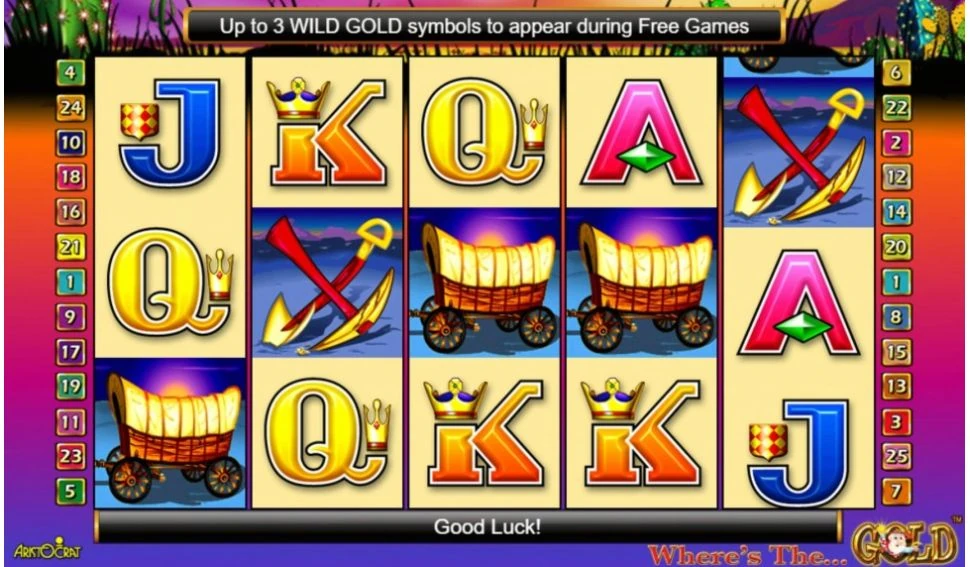
Common premium-style symbols in Where’s the Gold versions include things such as the prospector, mine shaft, mine cart, and related gold-rush icons. Lower-paying symbols usually include tools and card-style characters. Exact multipliers can vary by version, but the general pattern remains the same: premium symbols carry the best line-win potential, while lower symbols support the game’s everyday hit frequency.
| Symbol Type | 3 of a Kind | 4 of a Kind | 5 of a Kind | Relative Frequency |
|---|---|---|---|---|
| Prospector / top symbol | 5x line bet | 20x line bet | 100x+ line bet | Very low |
| Mine shaft / premium | 5x | 15x | 50x–75x | Low |
| Cart / premium-mid | 3x | 10x | 25x–50x | Low to Medium |
| Pickaxe / tool symbol | 2x | 5x | 15x–25x | Medium |
| Low symbols / card-style icons | 1x | 3x | 5x–10x | High |
Slide the table across to reach every column.
These figures are illustrative and may differ slightly between versions, but they reflect the usual shape of the paytable.
The wild symbol generally substitutes for regular paying symbols to help form winning combinations, though not usually for scatter or feature-trigger symbols. Wild support matters because it increases the chance of turning near-misses into actual line wins, particularly during stronger reel setups.
The scatter or feature symbol is more important for bigger outcomes. In many versions of Where’s the Gold, scatters are tied to free spins or a bonus sequence rather than paying the largest direct base-game reward. That’s a major part of the game’s payout identity: base spins keep things moving, while the feature often carries the more exciting upside.
| Outcome Type | Approx. Multiple of Total Bet | Long-Run Frequency |
|---|---|---|
| Tiny win | Less than 1x | Very frequent |
| Small win | 1x–10x | Frequent |
| Medium win | 10x–50x | Occasional |
| Big win | 50x–200x | Rare |
| Mega win | 200x+ | Very rare |
Slide the table across to reach every column.
That split helps explain why sessions can feel uneven. You might collect plenty of small returns without really moving ahead, then suddenly get a single feature or premium line hit that changes the entire session result.
Key payout takeaways:
The Where’s the Gold biggest wins question really has two parts: how much can the game theoretically pay, and what kinds of big wins are actually realistic in normal play?
The first answer is the theoretical max win. Every slot has a mathematically defined ceiling, usually expressed as a multiple of the total bet. In practice, that top figure represents an extremely rare combination—often requiring a near-perfect feature round with the strongest symbol setup available. While exact public figures can vary by version, games in this style commonly support large top-end outcomes measured in the hundreds or even thousands of times the stake.
The second answer is more useful for most players. Real-world big wins are often much lower than the true maximum, but still substantial. On Where’s the Gold, the more memorable payouts typically happen during free spins, especially when premium symbols stack well and wild assistance turns multiple paylines into winners at once.
A common example might be a player staking AUD 1.00 to AUD 2.00 per spin and hitting a feature that returns a four-figure payout. That sort of outcome is far more believable than the absolute max win and fits the behaviour of medium to medium-high volatility pokies with bonus concentration.
| Big Win Band | Example Scenario | Stake Example |
|---|---|---|
| 50x–99x | Strong line hit or decent feature | AUD 1.00 spin = AUD 50–99 |
| 100x–499x | Good free spins with premium connections | AUD 2.00 spin = AUD 200–998 |
| 500x–999x | Retrigger or stacked top symbols in bonus | AUD 1.00 spin = AUD 500–999 |
| 1000x+ | Exceptional feature sequence near top potential | AUD 2.00 spin = AUD 2,000+ |
Slide the table across to reach every column.
The biggest wins usually happen through one or more of the following:
It’s also worth noting that not all major payouts become public. Some casinos show recent win feeds in the lobby, but these are only snapshots. Privacy settings, venue policies, and reporting limits mean there is no complete public archive of every major Where’s the Gold win.
Practical takeaway:
A lot of players look up Where’s the Gold results today because they want a feel for what their own session might look like. The honest answer is that there is no daily pattern you can rely on. Because the game is RNG-based, today is not statistically better or worse than yesterday. What you can do, however, is understand the sort of session flow this pokie tends to produce.
In a typical 30 to 60 minute session at moderate stakes, the most common experience is a mix of small line wins, dead spins, and occasional moderate returns that partially refill the balance. Many wins in the base game won’t exceed the amount wagered by much. Their job is less about generating profit and more about slowing bankroll decline while you wait for a stronger event.
The biggest turning point in most sessions is the feature trigger. If no bonus lands, the session can feel heavy and expensive. If a feature does arrive—especially a decent one—it can recover a losing run quickly or push the balance into profit.
For example, a player starting with AUD 100 might have several realistic outcomes. They could lose the bankroll without landing a meaningful feature. They could hover around AUD 40 to AUD 90 for a while and finish with a small loss after lots of recycled wins. Or they could trigger a strong bonus and walk away with AUD 150, AUD 250, or more. Over short play, the first outcome is usually more common than the dream result.
| Spin Range / Event | Net Result vs Starting Bankroll | Notes |
|---|---|---|
| Spins 1–50 | -AUD 18 | Several small wins, no feature |
| Spins 51–100 | -AUD 35 | Dry stretch with a few minor returns |
| Spins 101–130 | -AUD 28 | Mid-size line hit reduces losses |
| Feature round triggered | +AUD 12 | Bonus pays around 40x total bet |
| Spins 131–180 | -AUD 5 | Balance fluctuates with mixed hits |
| Strong retrigger feature | +AUD 65 | Bigger feature shifts session into profit |
Slide the table across to reach every column.
This kind of example is useful because it shows how uneven results can be. A session may look poor for long stretches and then improve sharply, or it may never recover if the bonus underperforms or doesn’t land at all.
How to interpret your own results:
The smartest way to approach modern online play is with limits. Decide what you’re prepared to lose before you start, and if you hit a profit target you’re happy with, consider ending the session. That keeps Where’s the Gold win results today in the right context: entertainment outcomes, not a prediction model.
The reason Where’s the Gold can produce such different session outcomes from one run to the next is simple: a large portion of its value sits inside the bonus feature. While small base-game wins keep the balance alive, the feature round is often where the more meaningful payouts are generated.
In classic-style versions, the bonus is typically triggered by landing the required scatter or feature symbols, awarding a set number of free spins. Depending on the version, players may also see retrigger potential, extra wild assistance, or upgraded symbol behaviour during the feature. These mechanics are what turn a fairly ordinary session into one with real upside.
Feature results tend to follow a broad distribution. Quite a few bonus rounds deliver only moderate wins, often around 10x to 50x the total bet. That’s enough to soften losses or create a short-lived profit. Better feature rounds can pay 100x or more, especially if premium symbols line up across multiple reels or if the round retriggers and extends its value.
The rarest outcomes are the ones players remember and share: bonus rounds that stack strong symbols repeatedly, bring extra wild help, and approach the upper end of the game’s win potential. Those are possible—but they’re uncommon by design.
Another key point is how features affect the effective RTP of your session. If a large part of the game’s total return is concentrated in free spins, then any short session with no bonus can finish well below the headline RTP. On the other hand, landing multiple features in one session can push results well above average, at least temporarily.
That’s why the feature round is central to understanding Where’s the Gold payouts. Without it, the game can feel modest. With it, results can escalate quickly.
Although no strategy can force better Where’s the Gold results, the way you manage your stake has a major influence on how long your bankroll lasts and how much variance you can handle.
The first thing to understand is that max win potential is expressed as a multiple of your stake. So if the game pays 500x or 1000x on a strong result, the cash value of that win rises with your bet size. A AUD 1 spin and a AUD 5 spin can land the same multiplier, but the second result will obviously pay much more in dollars.
The downside is risk. Higher stakes burn through a bankroll faster, particularly on a medium to medium-high volatility game. If the bonus takes time to arrive, larger bets can shorten the session dramatically.
A sensible rule for many players is to keep each spin around 1% to 2% of the total bankroll if the goal is a longer session. So with AUD 100, a stake of roughly AUD 1 to AUD 2 may offer a more balanced experience than aggressive bet sizing. It doesn’t improve RTP, but it gives the maths more room to play out.
If your platform offers them and they’re legally available in your region, tools such as autoplay settings, stop-loss limits, and win caps can also help you stay in control. These don’t change the game’s underlying maths either, but they’re useful for discipline.
It’s equally important to ignore betting systems that claim to beat the slot. Methods like increasing your stake after losses do not change the RNG or improve long-term results. They simply increase volatility and can magnify losses.
Short sessions naturally produce more extreme outcomes—either better or worse than expectation. Longer sessions tend to move closer to the game’s theoretical profile, but the house edge still favours the operator over time. The goal of bankroll management is not to beat that edge, but to make your play more controlled and enjoyable.
Where’s the Gold sits in a familiar spot for Australian players who enjoy classic-style pokies. Compared with some modern online slots, its result profile is usually more straightforward: a recognisable line-win structure, a feature-driven upside, and medium to medium-high volatility rather than extreme all-or-nothing swings.
Against other popular Aussie favourites, the main differences tend to show up in three areas: RTP, volatility, and max win potential. Some games offer slightly higher RTP but feel more volatile, delivering fewer wins overall while relying on rare, bigger spikes. Others may offer steadier hit frequency but lower top-end excitement.
| Game Name | RTP (Approx.) | Volatility | Max Win Potential | Result Feel |
|---|---|---|---|---|
| Where’s the Gold | 95%–96% | Medium to Medium-High | Hundreds to 1000x+ depending on version | Frequent small hits, feature-led bigger wins |
| Queen of the Nile | 95%–96% | Medium | Moderate to high | Balanced play with classic free-spin rhythm |
| 5 Dragons | 95%–96% | Medium | Moderate to high | Fairly steady base game with bonus spikes |
| Buffalo-style games | 94%–96% | High | 1000x+ in some versions | Fewer routine wins, stronger bonus volatility |
| Dolphin Treasure | 95%–96% | Medium | Moderate | Softer swings, more familiar hit pattern |
Slide the table across to reach every column.
For many players, the appeal of Where’s the Gold lies in that middle ground. It doesn’t usually feel as flat as low-volatility titles, and it doesn’t always swing as wildly as the highest-volatility games. Instead, it delivers a classic pokie rhythm where base hits keep things ticking over and the real momentum tends to come from the feature.
If you’re choosing between titles based on likely session feel, that profile matters as much as the RTP figure itself.
Typical Where’s the Gold game results include lots of small line wins, occasional dead stretches, and bonus rounds that have the biggest influence on whether a session finishes well or poorly. In the base game, many returns are modest and often just recycle part of your stake. The more exciting results usually come from free spins, premium symbol combinations, or strong wild support. Because the game is medium to medium-high volatility, short sessions can vary sharply, so one player may see a feature early while another may not hit one at all.
The Where’s the Gold RTP commonly sits in the mid-90% range, with many online versions around 95% to 96%, although this can vary by operator and game configuration. In Australia, RTP may differ between online environments, venue-based versions, and jurisdiction-specific settings. The most reliable way to check the exact figure is through the game’s information or paytable panel before you play. Remember that RTP is a long-term theoretical number calculated over millions of spins, so it won’t guarantee a similar return in any individual session.
The biggest possible payout is the game’s theoretical max win, which is usually expressed as a multiple of your total bet. Depending on the version, this can reach the hundreds or thousands of times stake, but outcomes near the top limit are extremely rare. More realistic big wins often fall into the 100x to 1000x range, especially during free spins with strong premium-symbol coverage or retriggers. Most publicly discussed wins are well below the mathematical maximum, simply because the perfect combination needed to hit the top prize is uncommon.
No. There is no statistically proven best time to play Where’s the Gold for improved results. The game is run by an RNG, which means each spin is random and independent of previous ones. Time of day, day of the week, and earlier wins or losses do not influence your odds on the next spin. Ideas about the game being “hot,” “cold,” or “due” are common gambling myths. If you want a better playing experience, the only practical changes you can make are to manage your bankroll, choose a comfortable stake, and set limits before you start.
Results change because the game has volatility as well as random spin outcomes. A short session may include no bonus at all, several underwhelming features, or one strong feature that transforms the balance. Since a large share of the game’s return often comes from bonus rounds, missing them can make a session feel much worse than the listed RTP suggests. Hitting them early or multiple times can create the opposite effect. This is normal slot behaviour and doesn’t mean the game’s maths has changed between sessions.
Some casinos or gaming platforms may display recent big wins or a feed of notable payouts, but this is not the same as a true predictive tracker. These lists only show selected outcomes and do not reveal whether the game will perform well for the next player. In other words, you may be able to see snapshots of Where’s the Gold results today, but they have no forecasting value. They’re best treated as entertainment or proof that bigger wins are possible—not as a strategy tool for timing your session.
They can. The core theme and mechanics may be similar, but land-based and online versions can use different RTP settings, pacing, feature presentation, and stake structures. In Australia, venue machines may operate under different regulatory conditions and configuration ranges than online games offered through licensed operators in other jurisdictions. That means two versions of Where’s the Gold may feel broadly similar while still producing slightly different payout rhythms over time. Always check the game rules and RTP information for the exact version you are playing.
Where’s the Gold is designed to run on a certified RNG, which is the standard system used to ensure slot outcomes are random and independent. In regulated environments, these systems are tested to confirm that the game behaves according to its published rules and long-term mathematical settings.
RTP claims and game fairness are typically verified by independent testing laboratories, which assess whether the software performs as stated over large-scale simulation and compliance checks. That doesn’t mean any session will feel fair in the emotional sense—variance can still be sharp—but it does mean the game is not supposed to “choose” winners or losers based on time, player identity, or prior outcomes.
Just as importantly, no information page can guarantee specific Where’s the Gold win results. The numbers discussed here reflect theoretical return, volatility, and common payout behaviour, not promised results.
For safe play, remember:
If gambling is becoming difficult to manage in Australia, well-known support services include Gambling Help Online and the National Gambling Helpline. Reaching out early is always the best move.
If you want a broader picture beyond Where’s the Gold results, it helps to compare this page with other key parts of the site. A full game review can explain the visuals, mechanics, and feature flow in more detail. Bonus and promotions pages are useful if you want to see whether any welcome offers or free-spin deals apply to slot play. Banking pages can also help, especially for players who prefer familiar Australian-friendly methods such as PayID, bank transfer, Visa, Mastercard, and other supported payment options.
For the best experience, make sure the game information, RTP references, and feature details remain consistent wherever you view them. If this page includes an FAQ section on-site, implementing FAQPage schema is also a smart SEO step to improve visibility for long-tail searches around Where’s the Gold payouts, RTP, and results today.